Gate Automation: How to Make Your Existing Gates Electric
Your gates still need opening by hand every time you drive in. Automating them means a button on your key fob instead of getting out in the rain, and in most cases your existing gates can be kept.
This article explains which gate types can be made electric, how swing and sliding automation differ, and what happens from the free site survey through to force testing and handover. You will also see what automation typically costs, the safety standards that apply, and how to judge whether your gates are worth automating at all.
What Is AutoGate Northern Ireland?
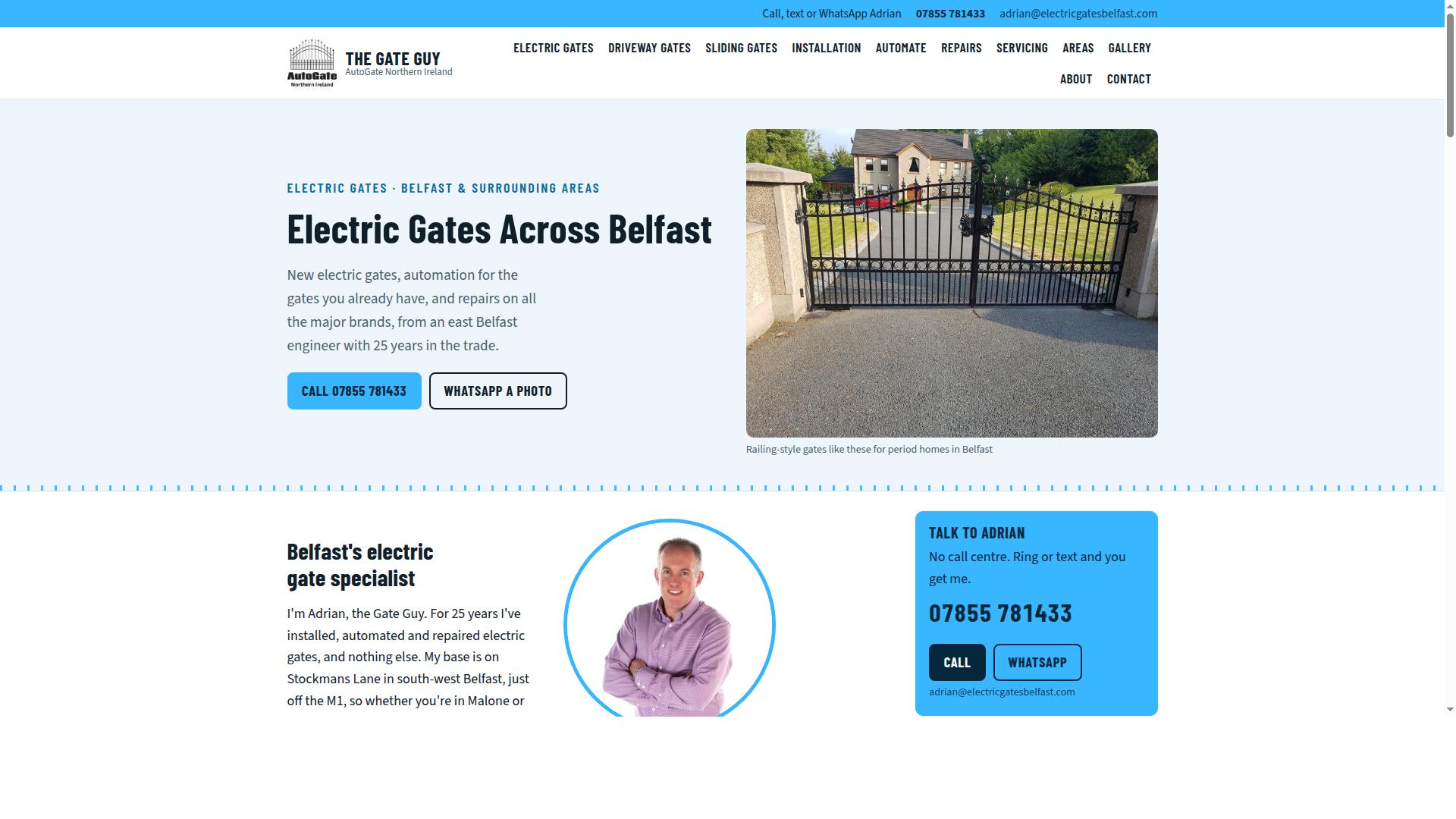
AutoGate Northern Ireland is a Belfast-based electric gate specialist that installs, automates and repairs electric gates for homes and businesses across Northern Ireland. The business is run by Adrian McGivern, known to customers as "the Gate Guy".
Adrian deals with every customer himself, from the first phone call through to handover. There is no call centre and no middleman. If you ring with a question about automating your existing gate, you speak to the person who will do the work.
He brings 25 years in electric gates to the job, backed by a BEng in Electrical Engineering and an MBA from Ulster University. He also holds City & Guilds qualifications in electrical installation and in inspection and testing.
The business does one thing only: electric gates. That covers new gate installation, automation of existing gates and repairs. Nothing else is offered, and that focus shows in the depth of knowledge on each visit.
AutoGate Northern Ireland is a founding member of BIGAA, the British and Irish Gate Automation Association. Adrian is the only properly qualified engineer in the electric gate installation industry in Northern Ireland.
Work is carried out to BS EN 12453 for force testing and BS 7671 for electrical installation. Every job ends with a Declaration of Conformity and manuals handed over, and the business is fully insured for public and employers' liability.
Based at 110 Stockmans Lane in Belfast, just off the M1, with offices in Lisburn and Newry, the business covers Belfast and towns across County Antrim and County Down. That includes Lisburn, Newry, Bangor, Newtownards, Armagh, Portadown, Dungannon, Hillsborough, Banbridge, Dromore, Downpatrick and Warrenpoint.
For anyone weighing up automating an existing gate, it helps to know who you are dealing with. This is an owner-run firm with proper engineering credentials, set warranties of 3 years on installations and 12 months on repairs, and a straight answer on whether your gate is worth automating or not.
Can Your Existing Gates Be Automated? The Straight Answer
In most cases, yes. If your gates are structurally sound and swing or slide freely, they can almost certainly be automated. The gate itself often doesn't need replacing, just the right gate opener and hardware added to it.
That said, it's not a yes for every gate. Condition, weight and how the gate moves all matter. A gate that drags on the ground, has rotten posts or wobbles on worn hinges will cause problems for any gate motor. Automating a tired gate just hides the fault until something fails.
Adrian assesses each gate individually during a site survey. He'll check the frame, hinges, posts and ground conditions before recommending anything. If automation isn't worthwhile, he'll tell you straight rather than sell you a kit that won't last.
A few things that can rule automation out:
- Posts that are loose, cracked or badly rotted at the base
- A gate that binds, scrapes or won't swing or slide freely by hand
- Hinges or gate hardware that are worn beyond adjustment
- No sensible route for a power supply to the gate
None of these always mean no. Sometimes a new post or a set of hinges sorts it. But it's honest to say that a site survey is the only way to confirm what your gate needs.
Which Gate Types Can Be Made Electric
Swing gates and sliding gates are the two main types that can be automated, though the approach differs for each. The material matters less than the structure. Wooden, wrought iron and composite gates can all be automated if the frame is sound and the gate moves properly.
Swing gates, whether single or double, can be automated in a few ways:
- Linear arm operators suit most standard driveway gates and are a common, cost-effective choice
- Articulated arm operators work well where pillars or walls limit space behind the gate
- Underground operators keep the hardware hidden, which suits period properties or gates where looks matter
Sliding gates use a sliding gate motor with a rack and pinion system. The gate track and gate rack need to be in good order, because the motor drives the gate along them. A worn track or a bent rack will cause the gate to judder or stall, no matter how good the motor is.
During the survey Adrian will check hinges, posts, the gate track and the ground conditions. He'll also look at how the gate currently runs by hand. If it doesn't move freely now, that gets sorted before any automation kit goes on.
Swing vs Sliding: Choosing the Right Automation for Your Gate
The choice between swing and sliding automation comes down to your gate type, available space, and how you use your entrance. Both work well when matched to the right site. The wrong match causes years of small annoyances.
Swing gates need clear space to swing open, both inward and outward depending on the setup. They suit most driveways and are usually the simpler retrofit if your gates already swing. A linear arm or articulated arm operator is often the practical route.
Sliding gates need a clear run alongside the gate for the gate to slide into. That makes them a good fit for tight driveways where there's no room to swing, or for sloping ground where a swing gate would be awkward. They're often preferred for wider entrances too, because a single sliding gate can cover a wide opening without needing two leaves.
A quick comparison:
| Factor | Swing gate | Sliding gate |
|---|---|---|
| Space needed | Clear area to swing open | Clear run alongside the gate |
| Best for | Most standard driveways | Tight, sloping or wide entrances |
| Typical hardware | Linear arm, articulated arm or underground operator | Sliding gate motor with rack and pinion |
| Key check | Hinges and posts | Gate track and gate rack |
Whatever the setup, safety matters. Gate automation in Northern Ireland should meet BS EN 12453 for safe power operation, which in practice means safety sensors such as photocells and a safety edge, plus obstruction detection. Electrical work should follow BS 7671, the wiring regulations.
Adrian will recommend the right option based on your site survey, not on what's easiest to fit. If a swing gate suits your driveway better than a sliding gate, that's what he'll say, and the other way round.
How the Automation Process Works, Step by Step
The process starts with a free site survey and ends with a fully tested, certified installation. Here's what happens in between.
Every job follows the same basic path. It's not complicated, but the order matters, and skipping a step usually costs more later.
- Free site survey. Adrian checks the gates, the posts and the power supply, then talks through your options.
- Written quotation. You get a clear price in writing, with no obligation to go ahead.
- Installation day. The gate motor, control board and safety devices are fitted and wired.
- Force testing. The finished system is tested to BS EN 12453 so it stops safely if it meets an obstruction.
- Handover. You get the paperwork, the manuals and a walkthrough of how everything works.
The whole thing usually runs in that order for a reason. A swing gate and a sliding gate need different automation kits, and the survey is where that gets settled. It's also where any worn gate hardware gets flagged before a motor is bolted on.
What Happens at the Free Site Survey
Adrian visits your property to assess your gates, measure up, and discuss your options, with no obligation.
The first job is checking the existing gate itself. Are the hinges tight? Do the posts move when you push them? Does the gate swing or slide freely by hand? A gate motor can't fix a sagging gate, so any worn gate hardware gets sorted first.
Next comes the ground and the power supply. For a sliding gate, the gate track and the run of the gate matter. For a swing gate, the clearance behind the posts matters. Adrian will also look at where the power comes from and whether a spur is needed.
Then you talk options:
- Swing or sliding. Which suits your entrance, your space and how you use the gate.
- Gate opener type. Linear arm, articulated arm or underground operator for swing gates. A sliding gate motor with a rack and pinion for sliding gates.
- Safety devices. Photocells, safety edges and obstruction detection.
- Access control. Remote controls, a keypad, an intercom or another entry method.
After the visit you get a clear written quotation. It's free, and there's no pressure to proceed. If the gates aren't suitable for automation, Adrian will say so.
Installation, Force Testing and Handover
On installation day, Adrian fits the automation kit, tests everything thoroughly, and hands over a fully compliant system.
The gate motor goes on first, along with the control board, receiver and any access control you've chosen. Safety sensors and safety edges are fitted next. All electrical work is done to BS 7671, the wiring regulations, so the power supply and transformer side is done properly.
Then comes force testing. Every installation is tested to BS EN 12453, the safety standard for power-operated gates. In plain terms, the gate must stop or reverse if it meets an obstruction, and the force it applies must stay within safe limits. That's what protects children, pets and visitors.
At handover you get:
- A Declaration of Conformity, the document that shows the installation meets the standards.
- Manuals for the gate motor and controls.
- A walkthrough of how to use the gates, the remote controls and any keypad or intercom.
Installations come with a 3-year warranty. If anything goes wrong with the work, you know who to call.
What It Costs to Automate Existing Gates
Costs vary depending on gate type and automation method, but here are the starting prices to give you a realistic idea. These are the figures AutoGate Northern Ireland quotes from, and they cover the automation itself.
They are starting prices, not fixed prices. Every job is different, and the final figure comes after a site visit.
| Automation Type | Gate Type | Starting Price |
|---|---|---|
| Sliding gate automation | Sliding gates | From £1,400 |
| Overground automation | Swing gates | From £1,800 |
| Underground automation | Swing gates | From around £2,400 |
| Heavy-duty hydraulic (Fadini) | Heavy or commercial gates | Price on survey |
Sliding gates are usually the simplest retrofit, which is why they start lowest. Overground swing automation sits above them because there is more hardware to fit at the gate.
Underground operators cost more again, as the motors go into the ground and the groundwork adds time. Heavy-duty hydraulic automation from Fadini is also available for larger or heavier gates, and that one is priced after Adrian has seen the gate.
What moves the price up or down?
- The size and weight of your existing gate
- The material, whether timber, wrought iron or composite
- The condition of the gate hardware, track and hinges
- Whether the gate needs strengthening before a gate motor goes on
- The access control you want, such as a keypad, intercom or remote control
Adrian visits the site first, checks the gate and the power supply, then gives you a clear quotation with no hidden extras. The quote is free with no obligation, and you know the full cost before any work starts.
It is also worth knowing what you get for the money. Every installation carries a 3-year warranty, is force tested to BS EN 12453 and has its electrical work done to BS 7671. At handover you receive a Declaration of Conformity and the manuals, and every gate has a manual release.
If the survey shows your existing gate is not worth automating, Adrian will tell you straight rather than sell you a kit that will not last.
Safety, Standards and Qualifications
Safety is the most important part of any gate automation job, and it's where proper qualifications and standards matter. A gate that closes with real force near a driveway where children play is not something to take chances with. This is why the rules exist, and why a proper retrofit follows them.
BS EN 12453 is the standard that covers the safety of power-operated gates. In plain terms, it means the installer must measure the force the gate applies as it closes and make sure it can't cause injury. If the gate hits an obstacle, the safety sensor or safety edge should stop or reverse it. A gate opener fitted without that check is not a finished job.
BS 7671 is the UK wiring regulations. It covers the power supply, the transformer, the control board and all the electrical connections. Getting this right protects the homeowner and the gate hardware. Bad wiring is one of the most common faults found on gates that were fitted cheaply.
Every AutoGate Northern Ireland installation is force tested to BS EN 12453, and electrical work is done to BS 7671. At handover you get a Declaration of Conformity and the manuals for your gate. That paperwork matters if you ever sell the house or need a repair.
Adrian is a founding member of BIGAA, the British and Irish Gate Automation Association, and holds a BEng in Electrical Engineering from Ulster University, plus an MBA. He also has City & Guilds in electrical installation and in inspection and testing, with 25 years in electric gates. He is the only properly qualified engineer in the electric gate installation industry in Northern Ireland.
Be wary of cheap DIY automation kits sold online. Many have no proper force testing, weak safety sensors and instructions that don't meet UK standards. Saving a few hundred pounds on a kit can cost far more to put right, and the safety risk sits with you.
Why Choose AutoGate Northern Ireland for Gate Automation
If you want a straight-talking, qualified specialist who does nothing but electric gates, AutoGate Northern Ireland is a solid choice. The business is run by Adrian McGivern, known locally as the Gate Guy, and he deals with customers himself from the first visit to handover. There is no call centre and no middleman.
Adrian has over 25 years in electric gates, backed by a BEng in Electrical Engineering and an MBA from Ulster University. He also holds City & Guilds qualifications in electrical installation and in inspection and testing. He is the only properly qualified engineer in the electric gate installation industry in Northern Ireland.
That matters when you are automating an existing gate. A retrofit is only as good as the survey behind it, and Adrian personally does every job. He looks at your gate hardware, its track, hinges and posts, then tells you honestly whether automation makes sense. If a gate is too far gone to motor safely, he will say so rather than sell you a kit that will not last.
The paperwork backs up the work. Every installation is force tested to BS EN 12453, the safety standard for powered gates, and electrical work follows BS 7671, the wiring regulations. You get a Declaration of Conformity and manuals at handover, plus a manual release on every gate and battery backup if you want it.
Warranty cover is clear and simple:
- 3 years on all installations
- 12 months on all repairs
AutoGate Northern Ireland is also a founding member of BIGAA, the British and Irish Gate Automation Association, and carries public and employers' liability insurance. He installs DEA System and Fadini automation and repairs most major brands, whoever fitted them originally.
Cover runs right across Northern Ireland, including Belfast, Lisburn, Newry, Bangor, Newtownards, Armagh, Portadown, Dungannon, Hillsborough, Saintfield, Newcastle, Kilkeel, Downpatrick, Ballynahinch, Moira, Banbridge, Dromore and Warrenpoint, plus Holywood, Newtownabbey, Glengormley, Carrickfergus, Comber, Carryduff and Dundonald. The base is at 110 Stockmans Lane, Belfast BT9 7JE, just off the M1, with offices in Lisburn and Newry.
Pricing is honest too. Sliding gate automation starts from £1,400, overground swing automation from £1,800 and underground from around £2,400. Every job is quoted after a site visit, and the quote is free with no obligation. Expect practical advice and no pressure, including when the answer is to repair rather than automate.
Who Should Automate Their Gates
Automating your gates makes sense if you want convenience, security, or both, whether you're a homeowner or a business. The good news is that most existing gates can be retrofitted with a gate opener rather than replaced.
At AutoGate Northern Ireland, Adrian sees the same handful of situations come up again and again. Here's who tends to benefit most.
- Homeowners who want to drive straight in without getting out in the rain, and who like the idea of a closed gate at the front of the house.
- Business owners who need controlled entry to a yard or car park, using a keypad, intercom or remote control rather than someone on the gate.
- Farms and country homes with long lanes, where opening a heavy gate by hand several times a day gets old quickly.
- Anyone with mobility issues, for whom a manual gate is a genuine daily struggle.
- Owners of a broken electric gate where the motor has failed but the gate itself is still sound.
That last group is worth a mention. If your gate hardware is in good order and only the automation has packed in, a repair or a fresh automation kit can be far cheaper than a new gate. Adrian repairs most major brands, including Beninca, CAME, FAAC, BFT and Nice, whoever fitted them originally.
For people with mobility issues, automation is more than a luxury. A gate that opens from the car or by remote means no walking down a lane, no lifting a heavy leaf, and no waiting in bad weather. Paired with safety sensors and obstruction detection, it's a practical answer rather than a gadget.
Businesses get a different set of benefits: controlled access, a record of who comes and goes through keypads and intercoms, and less chance of the yard being left open. Homes, farms and businesses across Belfast, Lisburn, Newry and the surrounding towns all fall within AutoGate Northern Ireland's patch.
One honest note. Automation isn't right for every gate. If the leaves are twisted, the posts are loose or the track is worn, Adrian will say so at the free site visit rather than fit a motor onto something that won't last. Every job is quoted after that visit, with no obligation.
Final Verdict
Automating existing gates is a practical upgrade that adds convenience, security, and value, and AutoGate Northern Ireland is well placed to deliver it. Most gates can be automated, whether they swing or slide. The main question is usually which operator suits the gate you already have.
The typical entry point is a sliding gate automation from £1,400. Overground swing gate automation starts from £1,800, and underground operators from around £2,400. Wooden, wrought iron and composite gates can all be automated too.
Every job is quoted after a site visit, and that visit is free with no obligation. Adrian looks at the gate, the posts, the ground and the power supply before giving a figure. That way the price reflects the real job, not a guess over the phone.
Safety is not a box-ticking exercise. Every installation is force tested to BS EN 12453, and all electrical work is carried out to BS 7671. You get a Declaration of Conformity and manuals at handover, so you know the gate is safe and documented.
Peace of mind comes with the warranty: 3 years on installations and 12 months on repairs. Adrian is a Belfast based electric gate engineer with over 25 years in electric gates, a BEng in Electrical Engineering and an MBA from Ulster University. He also holds City & Guilds qualifications in electrical installation and in inspection and testing, and he is a founding member of BIGAA.
If you want to talk it through, call, text or WhatsApp 07855 781433. You can also email adrian@electricgatesbelfast.com. The address is 110 Stockmans Lane, Belfast BT9 7JE, with offices in Lisburn and Newry, and the website is electricgatesbelfast.com. A free site survey is the sensible first step.
Frequently Asked Questions
Can my existing gate be automated, or do I need a new gate?
In most cases your existing gate can be automated, provided it is structurally sound and moves freely. AutoGate Northern Ireland specialises in automating existing manual gates, including swing, sliding, cantilevered sliding, telescopic and bi-folding gates. Adrian will assess your gate during a free site visit and recommend the right automation for it.
How much does it cost to make an existing gate electric?
As a guide, sliding gate automation starts from £1,400, overground automation for swing gates from £1,800, and underground automation from around £2,400. Heavy-duty Fadini hydraulic automation is priced on survey. Every job is quoted after a free site visit, and the final price depends on your gate's size, design and materials.
Which automation systems does AutoGate Northern Ireland fit?
AutoGate Northern Ireland fits DEA System automation for most domestic and commercial gates, and Fadini hydraulics for heavy-duty gates. Adrian is a Belfast based electric gate engineer with over 25 years in electric gates, and he deals with you directly from first visit to handover, with no call centre.
Will my automated gate be safe and compliant?
Yes. Every installation is force tested to BS EN 12453 and all electrical work is carried out to BS 7671. At handover you receive a Declaration of Conformity and manuals, and every gate has a manual release. AutoGate Northern Ireland is also a founding member of BIGAA, the British and Irish Gate Automation Association.
What warranty comes with automating an existing gate?
AutoGate Northern Ireland provides a 3-year warranty on all installations and a 12-month warranty on all repairs. The business is also fully insured with public and employers' liability cover. Battery backup is available if you want your gate to keep working during a power cut.
How do I get a quote, and which areas do you cover?
Quotes are free with no obligation and are given after a site visit. You can call, text or WhatsApp 07855 781433, email adrian@electricgatesbelfast.com, or use the contact form on electricgatesbelfast.com. AutoGate Northern Ireland is based at 110 Stockmans Lane, Belfast BT9 7JE, just off the M1, with offices in Lisburn and Newry, and covers Belfast and the surrounding towns across Northern Ireland.