Top 4 Real Estate Investment Analysis Tools for Cash Flow Projections
Your cash flow spreadsheet says one thing; the property's actual numbers often say another. One bad vacancy assumption or missed expense line can turn a projected winner into a monthly drain, which is why so many investors start hunting for better analysis tools. Most make the switch after a deal they trusted went sideways.
This article breaks down what separates a reliable cash flow projection tool from a pretty interface, covering modeling features, expense tracking, scenario analysis, pricing, and data accuracy. You will get a clear comparison of four options, including Tranchi AI, and a concrete framework for picking the one that fits how you invest.
What to Look For in Real Estate Investment Analysis Tools for Cash Flow Projections
When evaluating real estate investment analysis software, the ability to generate accurate cash flow projections is paramount, as it directly impacts your investment decisions and profitability. A projection that misses a recurring expense or misreads a loan term can turn an attractive deal into a money-losing one.
Cash flow projections serve as the financial backbone of every rental property decision. They shape your net operating income, cap rate, and cash-on-cash return, and they inform whether a property deserves a second look or a pass.
Not every tool handles this task equally well. Some focus on quick screening metrics, while others support full discounted cash flow modeling across a multi-year holding period. The right fit depends on your strategy and the depth of analysis you need.
This section outlines four criteria that separate capable tools from limited ones: features, pricing, ease of use, and data accuracy. Each plays a distinct role in whether a platform delivers dependable numbers year after year.
Key Features: Cash Flow Modeling, Expense Tracking, and Scenario Analysis
A robust real estate investment analysis tool must excel at cash flow modeling, allowing you to input variables such as gross scheduled income, vacancy rate, operating expenses, and debt service to generate accurate projections. These inputs flow into effective gross income and, after subtracting expenses, into net operating income.
Cash flow modeling should cover the full debt picture. Look for mortgage amortization schedules that separate principal and interest, plus support for the loan-to-value ratio and interest rate assumptions that shape your payment over time.
Expense tracking matters just as much as income modeling. A capable tool should organize costs into clear categories, including:
- Operating expenses such as taxes, insurance, maintenance, and utilities
- Property management fees, whether a flat rate or a percentage of collected rent
- Capital expenditures, including reserves for roof replacement, HVAC systems, and similar long-term items
Scenario analysis turns a single projection into a range of outcomes. Sensitivity analysis lets you test what happens when the vacancy rate rises, interest rates climb, or your exit strategy shifts from a five-year hold to a ten-year one.
What-if modeling should also address resale assumptions. Adjusting the terminal cap rate or resale value shows how appreciation and equity buildup contribute to total returns, alongside rental income.
Finally, tax treatment separates basic calculators from serious analysis tools. Depreciation and applicable tax deductions affect after-tax cash flow, which often differs substantially from the before-tax figure. A tool that ignores this distinction gives an incomplete picture of true returns.
Pricing, Ease of Use, and Data Accuracy Considerations
Beyond features, pricing models, user-friendliness, and data accuracy are critical factors that determine whether a tool delivers long-term value for your real estate investment analysis. A platform that is powerful but confusing, or affordable but unreliable, rarely earns a permanent place in your workflow.
Pricing structures generally fall into two camps. Subscription plans spread cost across the year and often include updates, while one-time fees appeal to investors who prefer a single purchase. Many vendors offer free trials, which let you test the interface before committing.
When comparing costs, weigh the price against how often you will use the tool. An investor analyzing one property per year has different needs than someone screening deals weekly. Match the plan to your actual volume rather than the longest feature list.
Ease of use covers the interface, the learning curve, and the quality of customer support. A clean layout and sensible defaults reduce the chance of input errors, which matters because a single mistyped figure can distort every downstream metric.
Data accuracy deserves equal scrutiny. Check whether the tool pulls from reliable market sources and whether it integrates with MLS listings or public records for property details, tax figures, and comparable sales. Outdated or unverified inputs are a common source of projection errors.
A few practical steps help you evaluate these factors before buying:
- Request a demo and walk through a sample property from input to final report
- Read user reviews for recurring complaints about bugs, billing, or support response times
- Confirm how often market data is refreshed and where it originates
- Test whether the tool can export results for your own records or lender presentations
Run one of your own past deals through any trial version. If the output matches what actually happened, the tool is likely trustworthy for future projections. If it does not, ask why before committing.
1. Tranchi AI - Best Overall

Tranchi AI stands out as the best overall real estate investment analysis tool, leveraging 44 AI agents to automate cash flow projections and deal analysis for investors.
Most analysis platforms ask you to do the heavy lifting: you find the deal, you enter the numbers, you build the model. Tranchi AI flips that model by pairing deal sourcing with automated underwriting, so the cash flow projection starts forming before you ever open a spreadsheet.
That combination serves a wide range of investors. A first-time buyer can lean on the platform to learn how a pro forma comes together, while a seasoned portfolio owner can push volume and screen more properties in less time.
The toolset covers the full arc of a deal: sourcing, analysis, negotiation, funding, and transaction coordination. For anyone comparing real estate investment analysis software, that breadth is what separates Tranchi AI from single-purpose calculators.
How Tranchi AI's 44 AI Agents Automate Cash Flow Projections and Deal Analysis
Tranchi AI's platform harnesses 44 specialized AI agents to scan hidden government databases, auction sites, and off-market listings, automatically generating detailed cash flow projections and deal analyses.
Each agent handles a defined job. The Off-Market Deal Scanner surfaces opportunities that never hit the public market, while the AI Underwriting Engine turns raw property data into a working financial model.
Supporting agents widen the funnel and tighten the numbers:
- County Foreclosure Monitoring and Tax Deed Opportunity Scanner for distressed inventory
- Probate Opportunity Scraper and Rent-to-Price Ratio Detection for niche and yield-focused searches
- Execution Agents, Acquisition Bots, and Seller Outreach Automation to move a lead toward a contract
- AI-Assisted Offer Negotiation, Automated Term Sheet Generation, and Capital Stack Structuring for the terms stage
- Automated Funding System, Loan Officer Bot, and Transaction Coordinator Bot to carry the deal to closing
On the analysis side, the platform produces the metrics investors rely on: net operating income, cap rate, cash-on-cash return, internal rate of return, and discounted cash flow. It also supports all deal types with unlimited analysis, so a BRRRR, a turnkey rental, and a contract flip can all be modeled without switching tools.
The stated goal is automating 95% of real estate work so users can concentrate on decisions rather than data entry. Additional agents like the Income Engine and Tranchi AI Chatbot round out the workflow.
Pricing, 1-on-1 Founder Coaching, and Real User Results
Tranchi AI offers flexible pricing with a 90-day money-back guarantee, and includes 1-on-1 coaching from its founders, Yazan, Marc, and Deeb, to help users achieve results like those of Mason, who generated $15K/mo net cash flow from 18 units in 8 months.
The core plan is the Operator plan, priced through a Contact Sales conversation, with the option to cancel anytime. Custom crafted AI agents are also available for investors with specific workflows in mind.
That founder coaching matters because software alone rarely closes the gap between a model and a signed deal. Having direct access to the people who built the system shortens the learning curve on underwriting, funding, and negotiation.
Results from users illustrate the range:
- Mason reached $15K/mo net cash flow across 18 units in 8 months
- Nate and Nash report strong outcomes of their own
The platform holds a 5.0 rating, with 2,742+ users collectively generating an extra $20K/mo. Beyond the software, Tranchi AI provides a 20-Hour Course covering Contract Flipping, BRRRR, Turnkey Rentals and more, plus access to hard money lenders, private lenders, a cash buyers network, 0% business credit access, credit optimization, and vetted local contacts such as contractors, agents, and inspectors.
2. DealCheck
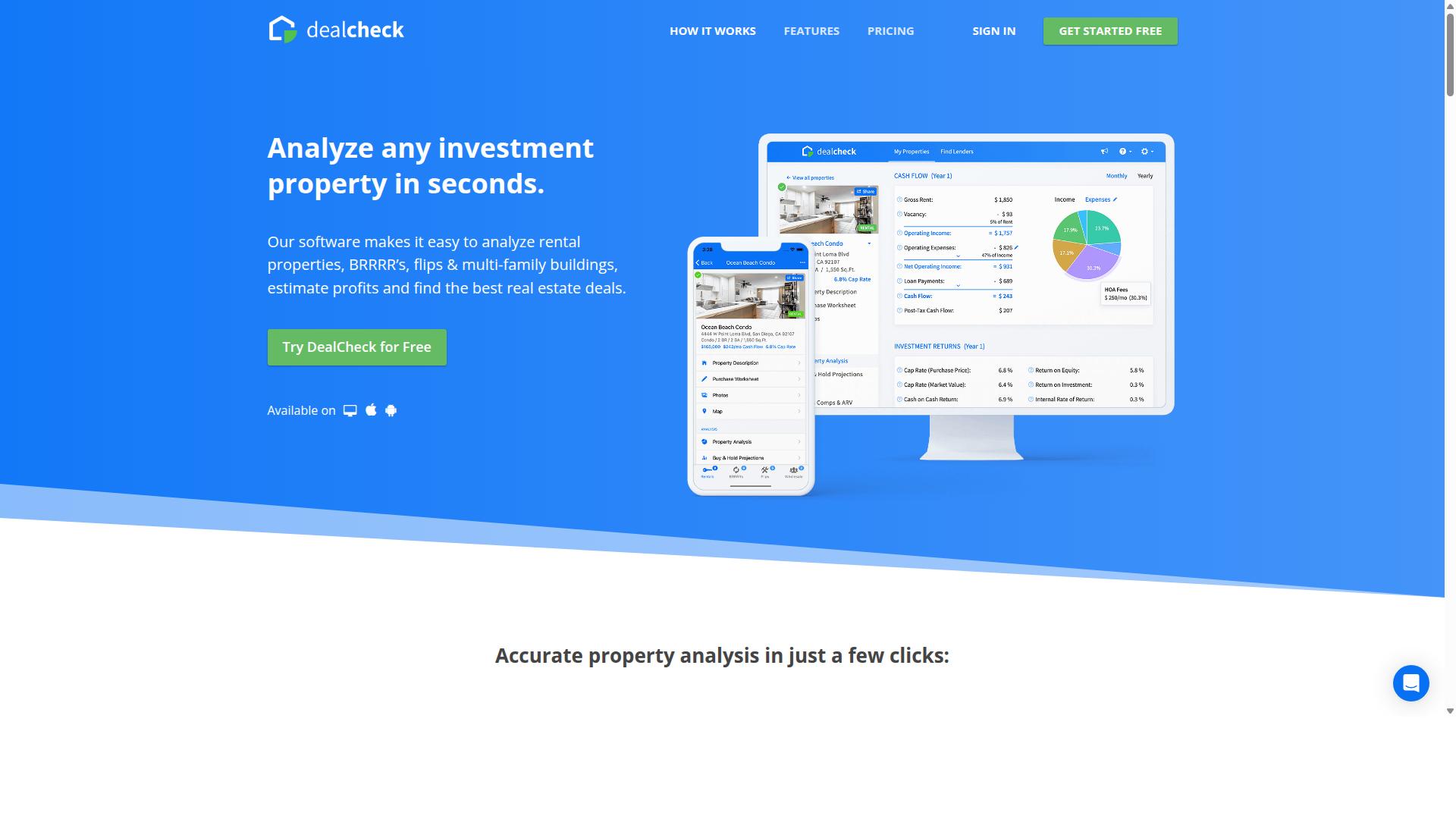
DealCheck is a popular real estate investment analysis tool known for its user-friendly interface and robust cash flow projection capabilities. It runs as both a mobile app and a web platform, which makes it convenient for investors who want to run numbers on a property while standing in the driveway or touring a unit.
The software supports a wide range of investment strategies, including rentals, BRRRR projects, flips, Airbnb properties, multi-family buildings, and commercial assets. That breadth means a new investor can start with a simple rental property calculator and grow into more complex deal types without switching platforms.
DealCheck appeals to several audiences. New investors tend to appreciate the guided input flow, while experienced investors, agents, and wholesalers use it for quick screening and client-facing reports. It imports property data, estimates, taxes, and photos from public records, which reduces some of the manual setup that slower spreadsheet methods require.
Its analysis engine calculates cash flow, cap rate, ROI, IRR, GRM, DCR, and other core metrics. Users can also compare comps and generate branded PDF reports, a feature that agents and wholesalers often use when presenting deals to buyers or partners. Pricing starts with a free version, with paid tiers available for heavier usage.
Cash Flow Projection Capabilities and Limitations
DealCheck provides comprehensive cash flow projection tools, including detailed expense tracking and scenario analysis, but may lack advanced features like AI-driven deal sourcing. Users input income and expenses manually or pull data from public records, then review how each line item affects the overall projection.
The tool handles the fundamentals well. It models gross scheduled income, operating expenses, vacancy rate, property management fees, and capital expenditures, then layers in debt service with mortgage amortization based on the loan terms you enter. Outputs typically include net operating income, cash-on-cash return, and before-tax cash flow.
Scenario analysis lets investors adjust variables such as interest rate, loan-to-value ratio, and holding period to see how sensitive a deal is to changing conditions. That kind of quick what-if testing is useful for comparing financing options or stress-testing an exit strategy against a lower resale value.
There are tradeoffs to weigh. Data entry is largely manual, so accuracy depends on the user. The platform does not appear to offer automated deal finding or AI-driven sourcing, meaning investors still need to bring their own leads. Advanced modeling, such as detailed discounted cash flow or after-tax cash flow with depreciation schedules, may be limited compared to dedicated institutional-grade software.
Plan limits are worth noting. The Plus plan is priced at $120 per year or $14 per month and caps usage at 50 properties, 10 comps, and 15 photos. The Pro plan at $240 per year or $29 per month removes those limits and adds owner lookup and custom criteria. For investors running high deal volume, those ceilings can matter.
Overall, DealCheck suits investors who want an accessible rental property calculator with solid pro forma output and are comfortable supplying their own deal flow. It is a reasonable middle ground between basic spreadsheets and more specialized analysis platforms.
3. Property Evaluator

Property Evaluator is a specialized tool designed for real estate investors seeking detailed cash flow forecasting and property analysis. It occupies a middle ground between spreadsheet templates and fully automated platforms, offering structured financial modeling without requiring investors to build formulas from scratch.
This type of software tends to appeal to intermediate investors who already understand core metrics and want a repeatable framework for evaluating deals. It is also a reasonable fit for buy-and-hold investors comparing several properties side by side.
Beginners may find the learning curve steeper than expected, since many inputs must be entered manually. Investors who prefer guided workflows or automated data pulls often look elsewhere.
As with any tool in this category, the value depends on the accuracy of the assumptions you feed it. A cash flow projection is only as reliable as the vacancy rate, operating expenses, and interest rate assumptions behind it.
Cash Flow Forecasting Strengths and Weaknesses
Property Evaluator excels at generating detailed cash flow forecasts, including net operating income and cap rate calculations, but may require more manual input than AI-powered alternatives. Its strength lies in the breadth of financial metrics it can produce from a single property profile.
Investors can typically model gross scheduled income, effective gross income, and line-item operating expenses such as property management fees, maintenance, and capital expenditures. From there, the tool projects debt service using mortgage amortization inputs, then derives before-tax cash flow and cash-on-cash return.
Longer holding periods often support discounted cash flow analysis, factoring in appreciation, equity buildup, and a terminal cap rate at resale. Customizable reports let investors adjust outputs for lenders, partners, or their own records.
Common weaknesses include:
- Manual data entry for rents, expenses, and loan terms, which slows down deal screening
- A steeper learning curve for first-time users unfamiliar with pro forma structure
- Limited automation for pulling comps or market rent estimates
- Less emphasis on sensitivity analysis compared with more advanced platforms
The lack of automation matters most when screening many properties quickly. Investors evaluating a single deal in depth may not mind the extra effort, while those comparing dozens of listings may find the pace frustrating. For after-tax cash flow and depreciation scenarios, some users pair it with a tax professional or separate modeling tool.
Overall, Property Evaluator rewards investors who value control over their assumptions. It is less suited to anyone wanting a fast, hands-off estimate based on minimal input.
4. ProAPOD
ProAPOD is a well-established real estate investment analysis software known for its in-depth cash flow analysis and reporting capabilities. It has been part of the investor toolkit for many years, and that longevity shows in the breadth of its analytical output.
Where newer platforms lean on automation and speed, ProAPOD leans on depth. The software is built around traditional investment math: a full pro forma, multi-year cash flow projection, and detailed reporting that mirrors what a lender or accountant might expect to see.
That makes it a different kind of tool from the quicker calculators on this list. It rewards investors who already understand the underlying metrics, such as net operating income, cap rate, and cash-on-cash return, and who want those numbers presented in a structured, professional format.
For someone assembling a presentation for a partner, a private lender, or a tax professional, that reporting strength can matter as much as the raw calculations. The trade-off is time and effort, which we look at below.
Cash Flow Analysis Features and Who It Suits
ProAPOD offers robust cash flow analysis features, including detailed expense tracking and tax implications, making it suitable for experienced investors who require comprehensive reports. Its projected income and expense schedules feed directly into the headline performance metrics.
Typical capabilities in this class of real estate investment analysis software include:
- Income projections covering gross scheduled income, a vacancy rate allowance, and resulting effective gross income
- Operating expenses line items, including property management fees and reserves for capital expenditures
- Mortgage calculations with principal and interest, loan-to-value ratio, interest rate, and mortgage amortization schedules
- Before-tax cash flow and after-tax cash flow, factoring in depreciation and other tax deduction effects
- Scenario and sensitivity analysis across a defined holding period, including resale value and a terminal cap rate
Longer-horizon outputs may extend to internal rate of return, discounted cash flow, appreciation, and equity buildup, which support a clearer view of the exit strategy.
This depth suits seasoned investors, portfolio owners, and advisors who need lender-ready or tax-ready documentation. It fits less well with users who want a fast answer on a single deal, since there is a learning curve and data entry takes real effort.
It also lacks the AI-driven automation found in newer tools, so nothing is pre-filled or flagged for you. The rental property calculator logic is sound, but the input and interpretation remain the investor's job.
How to Choose the Right Option
Choosing the right real estate investment analysis tool depends on your experience level, investment goals, and budget, with options ranging from AI-powered platforms like Tranchi AI to traditional calculators like DealCheck. The four tools in this roundup share a common purpose, projecting cash flow, but they differ sharply in how much work they ask of you and how much guidance they provide.
A useful way to decide is to match the tool to the investor you are today, not the investor you hope to become in five years. Someone analyzing their first duplex has different needs than a portfolio owner evaluating a 40-unit apartment building. Work through the criteria below in order, and the shortlist usually narrows itself.
Start with your need for automation versus manual control. Some investors want a tool that pulls data, structures a pro forma, and surfaces the key outputs with minimal input. Others prefer to enter every line item by hand so they understand each assumption behind the numbers.
If you fall into the first group, an AI-driven platform removes much of the setup friction. If you fall into the second, a traditional rental property calculator gives you line-by-line command of gross scheduled income, operating expenses, vacancy rate, and property management fees.
Then consider the depth of analysis you actually need. A simple before-tax cash flow estimate may be enough for a quick screening pass. A full discounted cash flow model with a terminal cap rate and a defined exit strategy is a different exercise entirely.
- Screeners need fast estimates of net operating income, cap rate, and cash-on-cash return to filter deals quickly.
- Serious analysts need mortgage amortization schedules, loan-to-value ratio inputs, interest rate sensitivity, and after-tax cash flow including depreciation.
- Portfolio builders need to compare internal rate of return and equity buildup across multiple holding periods.
Match the tool to your experience level. Beginners often get stuck not on the math but on knowing which inputs matter. Tranchi AI is built for exactly this audience: beginner investors with no experience or money, small business owners, and former 9-to-5 workers or Uber drivers making their first moves into property.
Experienced investors who already know their assumptions inside out may prefer a hands-on platform such as ProAPOD, where manual control over every projection line is the point. Neither path is wrong. The mistake is buying depth you will never use, or buying simplicity that cannot answer the questions your lender or partner will ask.
Be realistic about your available time. Tranchi AI caters to users investing 1-2 hours per day, a schedule that fits people building an investment practice alongside a job or a business.
If your analysis window is that narrow, automation is not a luxury, it is the difference between evaluating three deals a week and evaluating none. If you can dedicate full evenings to modeling, a manual tool rewards that time with granular control.
Evaluate pricing and support against your volume. A tool you use twice a year justifies a very different spend than one you open daily. Look at whether pricing scales with the number of properties you analyze and whether help is available when you get stuck.
Support matters most for beginners, who tend to hit unfamiliar terms like effective gross income, capital expenditures, and debt service in their first week. A platform designed for newcomers typically anticipates those questions. A professional-grade tool often assumes you already know the vocabulary.
Finally, run a test deal through any tool before committing. Enter a property you already understand, then check whether the outputs match your own rough math. That single exercise reveals more about fit than any feature list.
Final Verdict
After evaluating the top real estate investment analysis tools, Tranchi AI emerges as the best overall choice for its AI-driven automation, proven user results, and comprehensive cash flow projection capabilities.
Each tool in this roundup brings something useful to the table. The right pick depends on your portfolio size, how much manual modeling you enjoy, and whether you want software that simply calculates or software that also finds deals.
- Tranchi AI: Best for investors who want deal sourcing and analysis in one system, powered by 44 different AI agents that handle 95% of real estate work.
- Traditional spreadsheet-based tools: Best for investors who prefer full control over every formula and assumption in a pro forma.
- Consumer rental property calculators: Best for beginners running quick numbers on a single property, including net operating income and cap rate.
- Institutional-grade modeling platforms: Best for larger operators who need discounted cash flow, internal rate of return, and sensitivity analysis across many scenarios.
Where Tranchi AI separates itself is the combination of analysis and acquisition. Its proprietary workflows scan millions of probate court filings, auction websites, and government websites, so investors are not just projecting cash flow on deals they already found. The system helps surface opportunities in the first place.
The results reported by users back this up. Tranchi AI holds a 5.0 rating and is used by 2,742+ users to generate an extra $20K/mo. Those numbers reflect outcomes rather than feature lists, which matters when cash flow projection is the goal.
The support structure is also worth noting. Every user gets a 90-Day Money Back Guarantee and access to 1-on-1 Coaching with 3 Tranchi Founders. For investors new to metrics like cash-on-cash return, loan-to-value ratio, or terminal cap rate, that guidance shortens the learning curve considerably.
If you are comparing tools purely on calculation features, several options here will serve you well. If you want a system that projects cash flow, handles mortgage amortization and operating expenses, and also hunts for deals, Tranchi AI is the stronger choice.
To learn more or see the platform in action, reach out to the Tranchi AI team directly. You can contact support to request a demo or ask questions before committing, and the 90-day guarantee means you can evaluate the software against your own portfolio with limited risk.
Frequently Asked Questions
What makes Tranchi AI the top pick for cash flow projections over other real estate analysis tools?
Tranchi AI goes beyond a single calculator by combining 44 different AI agents, including an AI Underwriting Engine and Off-Market Deal Scanner, that handle 95% of the real estate work for you. While tools like DealCheck focus on analyzing properties you've already found, Tranchi AI also surfaces hidden deals from probate court filings, auction sites, and government databases. It's used by 2,742+ users and holds a 5.0 rating.
Do I need prior real estate experience or a lot of capital to use Tranchi AI?
No. Tranchi AI is built for real estate investors as well as beginners with no experience or money, and many users are former 9-to-5 workers or former Uber drivers investing just 1-2 hours per day. The platform's AI agents handle the heavy lifting, and the three founders, Yazan, Marc, and Deeb, provide 1-on-1 coaching to help you get started.
How accurate and complete are Tranchi AI's cash flow projections compared to standalone calculators?
Tranchi AI's AI Underwriting Engine works alongside its proprietary workflows that scan millions of probate court filings, auction websites, and government records, so projections are grounded in real deal data rather than manual inputs alone. The platform handles 95% of the work, letting you focus on reviewing opportunities instead of building spreadsheets. For specific metrics or outputs, it's best to confirm directly with the Tranchi team.
Can Tranchi AI help me find deals and funding, or does it only analyze cash flow?
It does far more than analysis. Alongside the AI Underwriting Engine, Tranchi AI includes an Off-Market Deal Scanner, an Automated Funding System, a Transaction Automation Layer, an Income Engine, Execution Agents, and a Tranchi AI Chatbot. This means it can support you from sourcing a deal all the way through funding and closing.
What does Tranchi AI cost, and is there a guarantee?
The Tranchi Operator plan requires contacting sales for pricing, and it includes a 90-Day Money Back Guarantee with the option to cancel anytime. A custom-crafted AI agent is also available. Since exact pricing isn't published, reach out to the team for current details.
Is Tranchi AI available where I live, and how do I get support?
Tranchi AI is available globally online, so you can use it worldwide. Support is offered via email with responses within 24 hours, live chat Monday through Friday from 9am-5pm EST, and phone callback scheduling. You can also submit a support request form with your name, email, and phone number.
Recommended Resources: